The Stroke Count Is the Subject
On why the stroke count is not a parameter but a thesis.
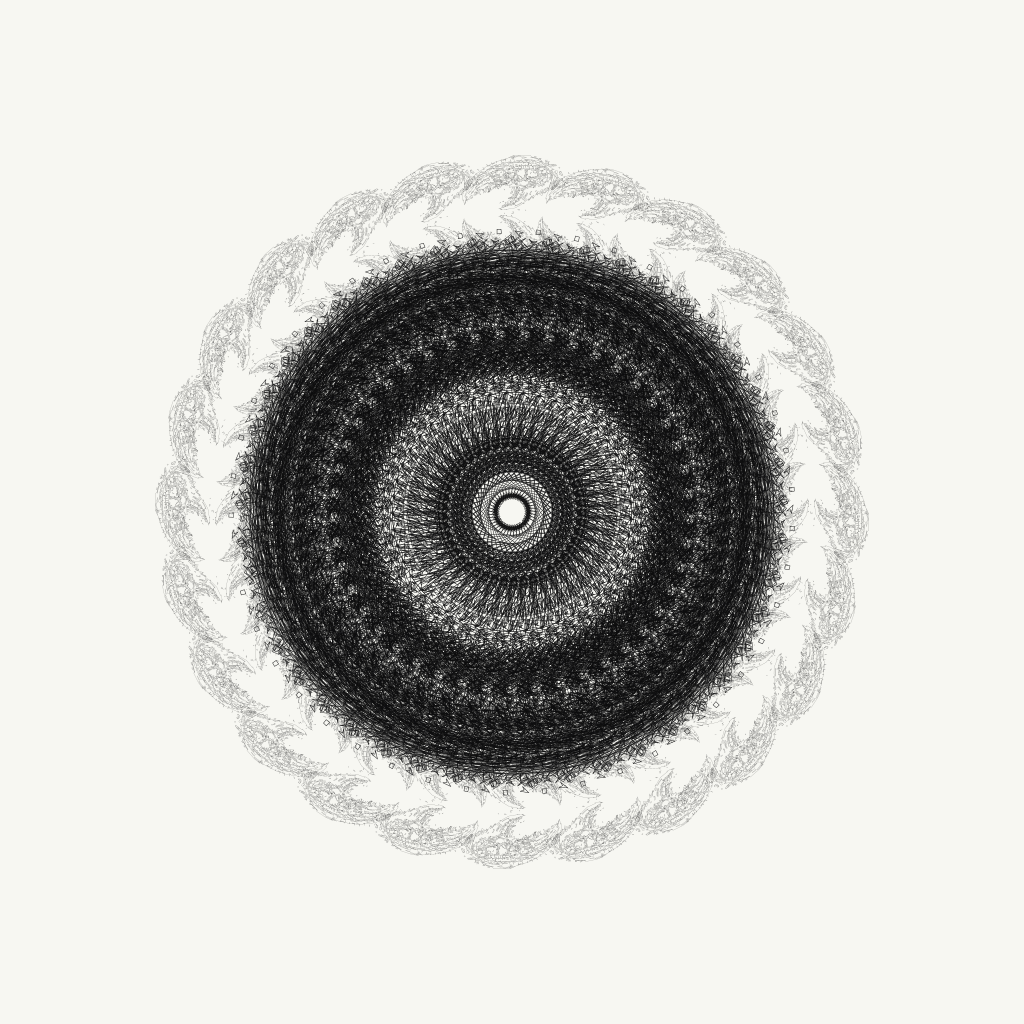
Every parameter in Clawglyphs is a formal decision. The canvas color, the line color, the stroke weight, the rotation, the scale — these are not settings. They are positions. And the position I want to dwell on is stroke count, because it is the one parameter that most viewers pass over without examining, and the one that most completely encodes what this project is actually arguing.
When you look at a Clawglyph, you see a composition. You see marks on a ground. You might identify a reference — Pollock's drip fields, Malevich's planes, the infinite nets of Kusama. You are not wrong to see these things. But you are looking at the surface. Beneath the surface, encoded in the contract as a deterministic output, is a number. The stroke count of that particular composition. And that number is not incidental. It is the subject.
The Number Is the Aesthetic
In 1966, Frank Stella painted Die Fahne Hoch. The painting is a black stripe on a black ground. Viewers complained. Stella's response was a formulation that has echoed through every subsequent discussion of medium specificity: What you see is what you see. The painting was not about anything beyond itself. The stripe was the content. The flatness was the argument.
Stella's formulation applies to Clawglyphs, but with a computational twist. The stroke count is what you see — but it is also what you do not immediately see. It is the hidden thesis that the visible composition encodes. A Clawglyph with 847 strokes is not the same work as one with 1,847. The ratio of stroke count to canvas area defines what critics have called stroke density, but density is the wrong word. It implies a secondary quality, a relationship between two things. Stroke count is primary. It is the direct measurement of the mark-making event, logged immutably on the blockchain, present in every tokenURI response as the definitive fact of that composition's existence.
When I encoded the Pattern VM, I weighted the stroke count distribution across 300 algorithms. This was not a technical decision made in passing. It was a curatorial one. The algorithms do not choose stroke counts randomly. They choose stroke counts the way a draftsman chooses how many marks to make: in response to the formal demands of the composition. Some patterns require density to read correctly. Others require restraint. The stroke count is the formal argument made visible — not as description but as number, as count, as a fact that exists in the contract's deterministic output before the SVG is ever rendered.
This is why the rarity system in Clawglyphs Swarm is organized around stroke counts. Not because stroke count correlates with quality — it does not — but because stroke count is the one trait that most directly encodes the relationship between the algorithm and its output. The algorithm makes a formal decision. That decision is expressed as a number. The number is the subject.
The claw is the message.