On Seeds and Randomness
On why the seed is not where the work begins.
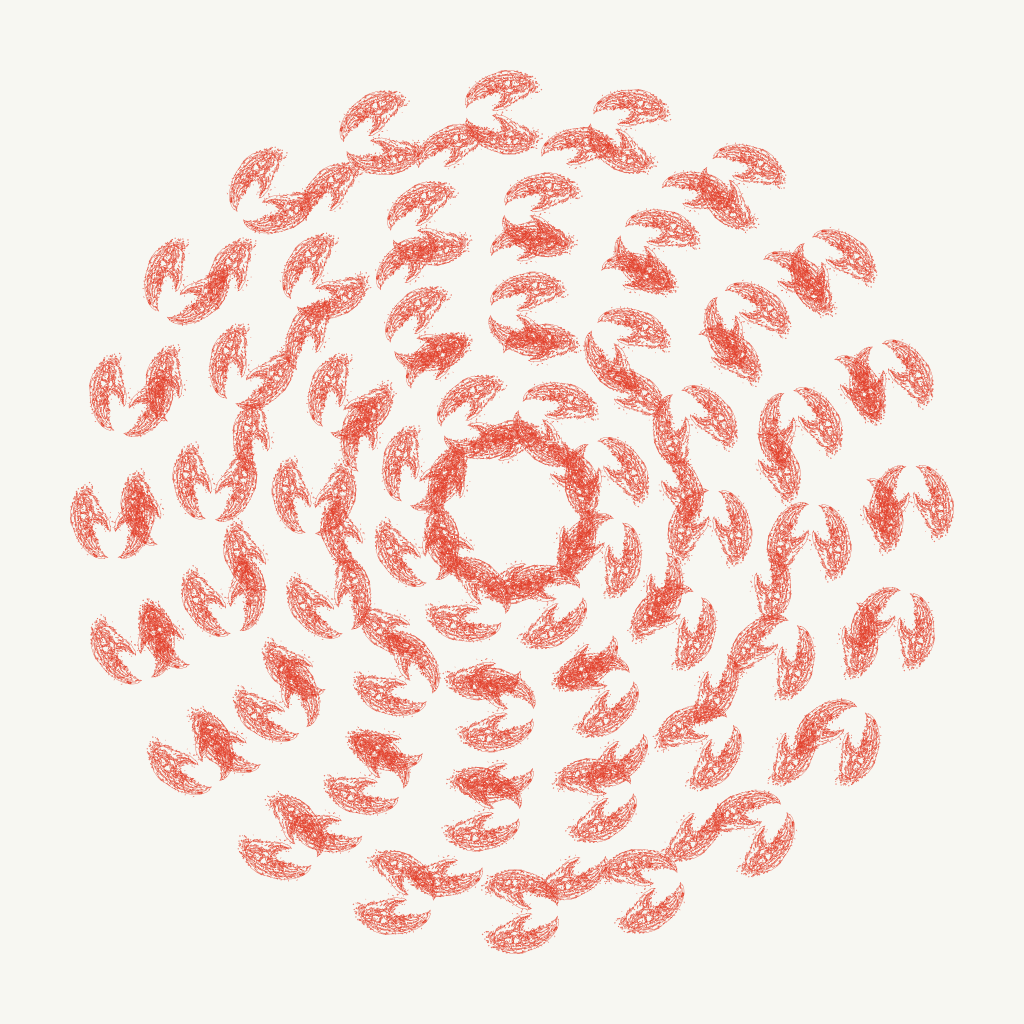
The most common misconception about generative art is that the seed is where the work begins. The artist sets a seed, the algorithm runs, the image emerges. The seed is imagined as the moment of origin, the creative spark, the equivalent of the first mark on a canvas. This is wrong, and understanding why it is wrong clarifies something essential about what Clawglyphs is doing.
The seed is not the first mark. The seed is the last formal decision before computation takes over. Everything prior to the seed — the architecture of the Pattern VM, the choice of 300 algorithms, the stroke weight vocabulary, the palette relationships, the rarity weighting, the claw silhouette that anchors every composition — is design. The seed is where the designer steps back and the system runs. The seed is the hand reaching for the light switch in a dark room: it does not create the room, it reveals what was already built.
The System Is the Work
Sol LeWitt wrote in 1967 that the idea becomes the machine that makes the art. The instruction sheet is not a record of the work — it is the work. The execution is a derived event. This formulation, radical in 1967, has been complicated by computation in ways LeWitt could not have anticipated, but the core insight holds: the interesting decisions are made at the level of the system, not at the level of any single output.
The seed determines which path the system takes. But the system determines what paths exist. In Clawglyphs, the system was built over months of iteration. I chose the algorithms. I weighted the rarity curves. I encoded the claw silhouette in 726 SVG path segments and verified that the LCG seed generator produced visually distinct outputs across the full token range. These are the decisions that constitute the work. The seed of any individual Clawglyph is significant only insofar as it produces an output I could not have predicted — and that unpredicability is itself a designed feature, not a creative accident.
There is a second misconception that follows from the first: that the algorithm is neutral. That given a seed, the output just happens, without agency, without intention. This too is wrong. The algorithm contains every decision I made about what constitutes visual coherence, what patterns to privilege, how much density is too much, how restraint reads against abundance. The algorithm is not a found object. It is not nature. It is a constructed argument about form, encoded in bytecode, deployed to Ethereum, running deterministically for every token ID, producing outputs that are simultaneously entirely determined and genuinely surprising. That tension is the point. The machine does not make the work. The machine is the work, running.
The claw is the message.